

Recent Files shows every file that was created or uploaded across all your Langdock conversations. AI-generated documents and slides, files you uploaded to a chat, and files imported from connected integrations all appear here.Documentation Index
Fetch the complete documentation index at: https://docs.langdock.com/llms.txt
Use this file to discover all available pages before exploring further.
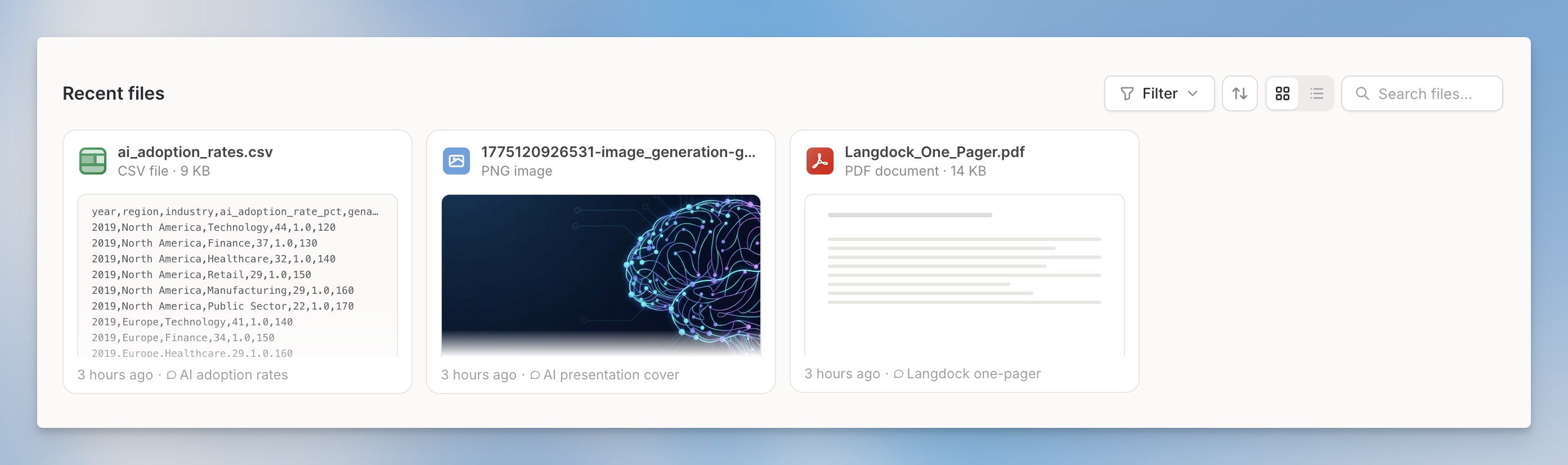
What appears in Recent Files
Recent Files shows files based on their origin:| Origin | What it includes |
|---|---|
| Generated | Documents and presentations created by Langdock in chat |
| Uploaded | Files you uploaded directly to a conversation |
| Imported | Files pulled in from connected integrations |
Recent Files follows your workspace’s chat data retention settings. When a chat is deleted, the files associated with it are removed from Recent Files as well.
Grid and list view
Toggle between grid view (thumbnails) and list view (rows with details) using the view switcher in the top-right corner of the Recent Files section. Your preference is saved automatically.Filtering
Use the filter controls to narrow down files:- File type: Documents, Presentations, or PDFs
- Date: Filter by creation date range
- Origin: Uploaded, Generated, or Imported
File actions
Each file has a set of actions available from its context menu or action bar:| Action | Description |
|---|---|
| Preview | Open a preview of the file |
| Download | Download the original file |
| Jump to chat | Open the original chat the file came from |
| Start chat | Open a new chat with this file attached |
| Move to folder | Move the file into a Folder |
| Delete | Remove the file permanently |
File preview
Files can be previewed in three ways: Inline thumbnail. Visible directly on each file card in grid view. Hover over a multi-page file to scrub through its pages. Side panel. Click a file to open a resizable side panel preview without leaving the Library. Full-screen. Open the full-screen view for a larger preview. Multi-page files (documents, presentations) show a slide thumbnail strip for quick navigation. Presentations also support a presenter mode.Batch actions
Select multiple files using Shift + click to enable batch actions. A bar appears at the bottom with options to:- Download all selected files
- Move to folder: moves all selected files into a Folder at once
- Delete all selected files